MMTSA: Multi-Modal Temporal Segment Attention Network for Efficient Human Activity Recognition
2023年9月1日·
 ,
,
,
,
·
0 分钟阅读时长
,
,
,
,
·
0 分钟阅读时长
Ziqi Gao
Co-first Author
Yuntao Wang
Co-first Author
,
Jianguo Chen
Junliang Xing
Shwetak Patel
Xin Liu
Yuanchun Shi
摘要
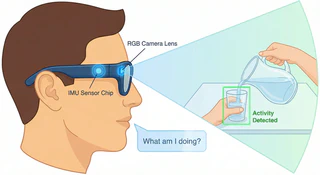
Multimodal sensors provide complementary information to develop accurate machine-learning methods for human activity recognition (HAR), but introduce significantly higher computational load, which reduces efficiency. This paper proposes an efficient multimodal neural architecture for HAR using an RGB camera and inertial measurement units (IMUs) called Multimodal Temporal Segment Attention Network (MMTSA). MMTSA first transforms IMU sensor data into a temporal and structure-preserving gray-scale image using the Gramian Angular Field (GAF), representing the inherent properties of human activities. MMTSA then applies a multimodal sparse sampling method to reduce data redundancy. Lastly, MMTSA adopts an inter-segment attention module for efficient multimodal fusion. Using three well-established public datasets, we evaluated MMTSA’s effectiveness and efficiency in HAR. Results show that our method achieves superior performance improvements (11.13% of cross-subject F1-score on the MMAct dataset) than the previous state-of-the-art (SOTA) methods. The ablation study and analysis suggest that MMTSA’s effectiveness in fusing multimodal data for accurate HAR. The efficiency evaluation on an edge device showed that MMTSA achieved significantly better accuracy, lower computational load, and lower inference latency than SOTA methods.
类型
出版物
Proc. ACM Interact. Mob. Wearable Ubiquitous Technol.

Authors
Associate Professor (Research Track)
Yuntao Wang’s research centers on physiobehavioral computing and
intelligent interaction for mobile and wearable systems. His work
focuses on (1) developing robust, efficient sensing that performs
reliably on mainstream devices, (2) extracting spatiotemporal patterns
from multimodal signals to infer interaction intent by leveraging
natural behavioral correlations, and (3) designing edge-efficient interfaces
that deliver high performance on mobile and wearable platforms.
He has published 90+ papers, received 10 international conference awards,
and holds 30+ granted patents. His contributions have been
recognized with honors including the Wu Wenjun AI Outstanding Youth
Award (2024), the CAST Young Elite Scientists Sponsorship Program (2022),
the Qinghai High-Level Innovation & Entrepreneurship Leading Talent (2024),
and the First Prize of the China Electronics Institute Science & Technology Award (2019).