Computing with Smart Rings: A Systematic Literature Review
September 1, 2025·
,
,
,
,
,
,
,
,
,
,
,
,
,
,
 ·
0 min read
·
0 min read
Zeyu Wang
Ruotong Yu
Xiangyang Wang
Jiexin Ding
Jiankai Tang
Jun Fang
Zhe He
Zhuojun Li
Tobias Röddiger
Weiye Xu
Xiyuxing Zhang
Huan-ang Gao
Nan Gao
Chun Yu
Yuanchun Shi
Yuntao Wang
Abstract
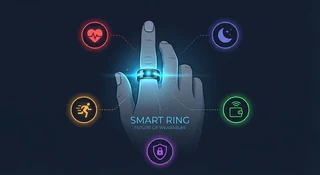
A smart ring is a wearable electronic device in the form of a ring that incorporates diverse sensors and computing technologies to perform a variety of functions. Designed for use with fingers, smart rings are capable of sensing more subtle and abundant hand movements, thus making them a good platform for interaction. Meanwhile, fingers are abundant with blood vessels and nerve endings and accustomed to wearing rings, providing an ideal site for continuous health monitoring through smart rings, which combine comfort with the ability to capture vital biometric data, making them suitable for all-day wear. We collected in total of 206 smart ring-related publications and conducted a systematic literature review. We provide a taxonomy regarding the sensing and feedback modalities, applications, and phenomena. We review and categorize these literatures into four main areas: (1) interaction - input, (2) interaction - output, (3) passive sensing - in body feature, (4) passive sensing - out body activity. This comprehensive review highlights the current advancements within the field of smart ring and identifies potential areas for future research.
Type
Publication
Proc. ACM Interact. Mob. Wearable Ubiquitous Technol.

Authors
Associate Professor (Research Track)
Yuntao Wang’s research centers on physiobehavioral computing and
intelligent interaction for mobile and wearable systems. His work
focuses on (1) developing robust, efficient sensing that performs
reliably on mainstream devices, (2) extracting spatiotemporal patterns
from multimodal signals to infer interaction intent by leveraging
natural behavioral correlations, and (3) designing edge-efficient interfaces
that deliver high performance on mobile and wearable platforms.
He has published 90+ papers, received 10 international conference awards,
and holds 30+ granted patents. His contributions have been
recognized with honors including the Wu Wenjun AI Outstanding Youth
Award (2024), the CAST Young Elite Scientists Sponsorship Program (2022),
the Qinghai High-Level Innovation & Entrepreneurship Leading Talent (2024),
and the First Prize of the China Electronics Institute Science & Technology Award (2019).