Modeling the Trade-off of Privacy Preservation and Activity Recognition on Low-Resolution Images
January 1, 2023·
 ,
,
,
,
,
,
,
,
,
·
0 min read
,
,
,
,
,
,
,
,
,
·
0 min read
Yuntao Wang
Zirui Cheng
Xin Yi
Yan Kong
Xueyang Wang
Xuhai Xu
Yukang Yan
Chun Yu
Shwetak Patel
Yuanchun Shi
Abstract
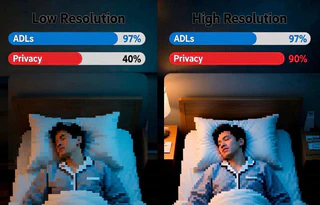
A computer vision system using low-resolution image sensors can provide intelligent services (e.g., activity recognition) but preserve unnecessary visual privacy information from the hardware level. However, preserving visual privacy and enabling accurate machine recognition have adversarial needs on image resolution. Modeling the trade-off of privacy preservation and machine recognition performance can guide future privacy-preserving computer vision systems using low-resolution image sensors. In this paper, using the at-home activity of daily livings (ADLs) as the scenario, we first obtained the most important visual privacy features through a user survey. Then we quantified and analyzed the effects of image resolution on human and machine recognition performance in activity recognition and privacy awareness tasks. We also investigated how modern image super-resolution techniques influence these effects. Based on the results, we proposed a method for modeling the trade-off of privacy preservation and activity recognition on low-resolution images.
Type
Publication
Proceedings of the 2023 CHI Conference on Human Factors in Computing Systems
Human Activity Recognition
Privacy
Activities of Daily Living (ADLs)
Low-Resolution Image.
Privacy Preserving
Visual Privacy

Authors
Associate Professor (Research Track)
Yuntao Wang’s research centers on physiobehavioral computing and
intelligent interaction for mobile and wearable systems. His work
focuses on (1) developing robust, efficient sensing that performs
reliably on mainstream devices, (2) extracting spatiotemporal patterns
from multimodal signals to infer interaction intent by leveraging
natural behavioral correlations, and (3) designing edge-efficient interfaces
that deliver high performance on mobile and wearable platforms.
He has published 90+ papers, received 10 international conference awards,
and holds 30+ granted patents. His contributions have been
recognized with honors including the Wu Wenjun AI Outstanding Youth
Award (2024), the CAST Young Elite Scientists Sponsorship Program (2022),
the Qinghai High-Level Innovation & Entrepreneurship Leading Talent (2024),
and the First Prize of the China Electronics Institute Science & Technology Award (2019).